The Last Experiment of the Eternal Isle
I. Do You Know?
The First Dream of Eternal Life
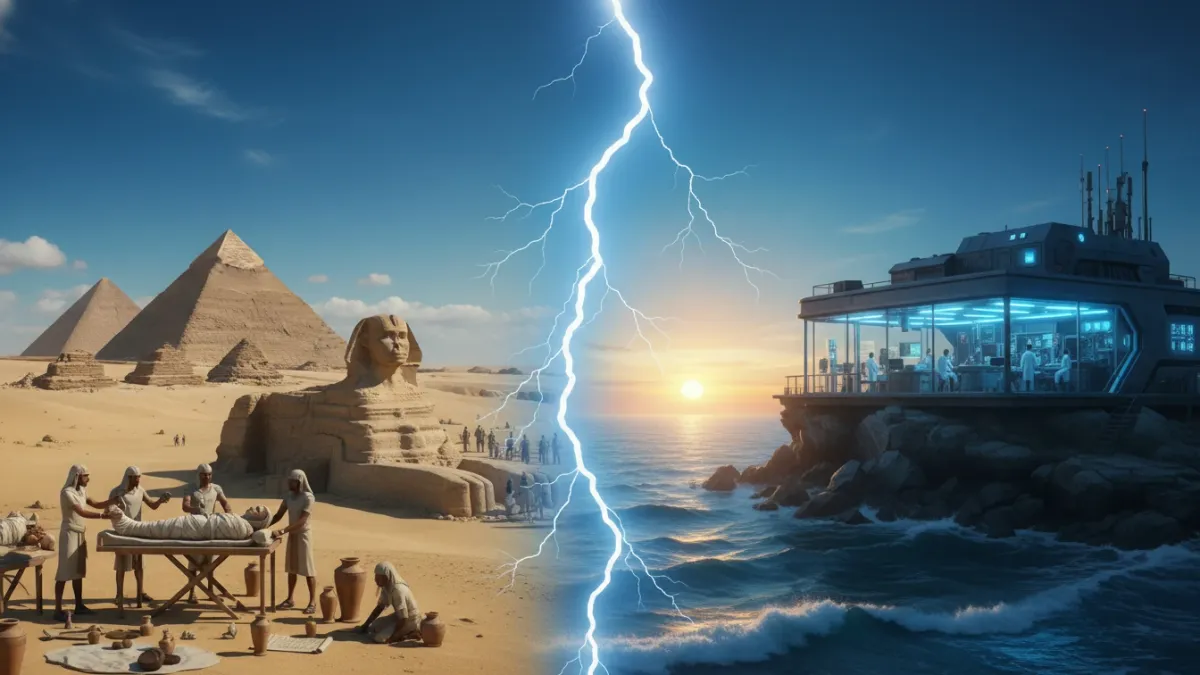
Do you know that the ancient Egyptian obsession with immortality wasn’t merely religious devotion, but humanity’s first great scientific project? Before modern medicine, before biology, before the first microscope lens was polished, there was the embalmer’s blade, the priest’s whisper, and the long, slow engineering of eternity.
The Egyptians believed that life continued after death, but only if the body endured. The very first mummies were not royalty—they were failed attempts to stop decay, bodies accidentally preserved by desert heat. But soon this became deliberate, exact, ritualized.
Some details feel almost unbelievable today:
- Onions were sometimes placed in body cavities or even used as false eyes, because they symbolized rebirth.
- One 11th-dynasty mummy was wrapped in over 9,000 feet of linen—enough to cover three tennis courts.
- During the Middle Ages, Europeans powdered mummies into “medicine.” Kings rubbed mummy dust onto their skin, hoping for strength, vitality, even greatness.
- King Ramses II once traveled the world with his own passport, occupation listed simply as “King.”
- The embalmers started the process by removing internal organs through a single long incision. The man who made that cut was literally called the “ripper-up.”
- The only organ left inside was the heart, believed to be weighed by the gods and judged.
- In one case, embalmers accidentally left the brain hook inside a mummy’s skull, giving modern scientists a perfect artifact of the process.
- And yes—Tutankhamun was buried with a mummified erect penis, meant to let him resemble Osiris, the very first mythical mummy.
The more we discover, the stranger it becomes. A mummy can be a king, a pauper, a cat (Egyptians mummified over a million cats), or even a wasp (a modern Ecuadorian species wraps its prey in silk like tiny embalmers).
But beneath all the linen, oils, beeswax, and natron, the Egyptians pursued one idea:
If the body survives, life may return.
Eternity must be engineered.
That ancient hope—revival by the gods—was humanity’s first blueprint for immortality.
II. Modern Quest for Eternity
We pretend we are beyond such superstition, but are we?
Modern scientists chase longevity with equal fervor:
- Cryogenic vaults store bodies in liquid nitrogen, waiting for futures that may never come.
- Geneticists attempt to silence aging genes or repair them.
- Bio-engineers grow synthetic skin and replace failing tissues with 3D-printed organs.
- And in preserved mausoleums like Lenin’s, modern embalmers replace skin and flesh with polymers to hold on to the illusion of life.
A person from ancient Egypt, transported to our time, would not think we abandoned their dream. They would believe we’re simply building better gods.
III. Intro
The Scientist of the Eternal Isle
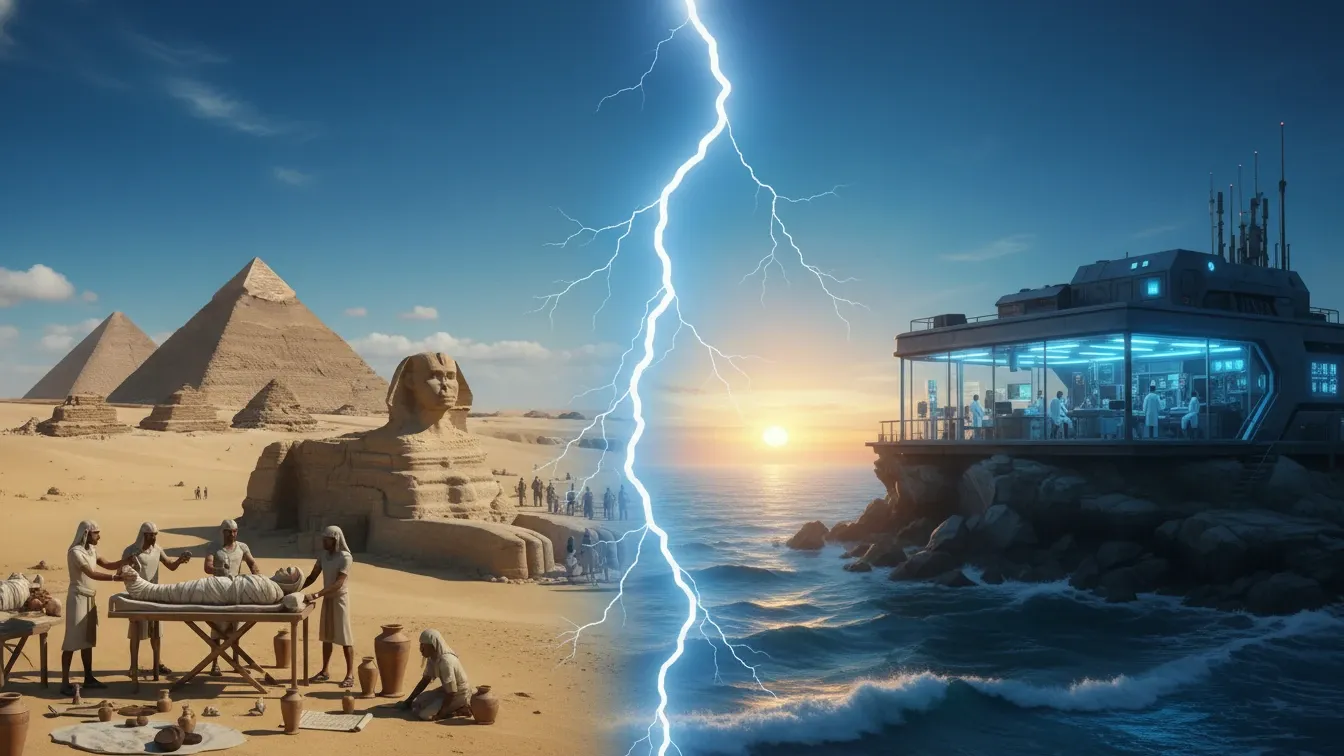
This story begins where the old dream meets the new one.
It begins with a scientist, a modern man, brilliant and unbound by any authority but his own curiosity.
He lives on an isolated island where no ships anchor, where no other adults are allowed. Only children live with him—children he calls his pupils. He shelters them, feeds them, teaches them language, mathematics, mythology, and science. But he also teaches them something else:
He teaches them that humans live a thousand years.
And he pretends—calmly, convincingly—that he is already three hundred.
Why would a scientist fabricate such an extraordinary lie?
Why build a world with only children?
Why erase from their minds the true span of human life?
Some say it is an experiment in psychology.
Some say it is an experiment in biology.
Some say he is unravelling.
Some say he is proving a point no one else was brave enough to ask.
But his story, like all stories of immortality, begins not with him,
but with a pharaoh and the teacher who taught him the first lesson of eternity.
IV. The Story
1. The Pharaoh and the Teacher of Death
The young pharaoh, not yet crowned, sat in the cool shadow of Djoser’s Step Pyramid—the oldest staircase to heaven ever built. The desert shimmered around them, as if the air itself trembled at the weight of history.
His teacher, the old priest Meresh, carried a cane made from tamarisk and a mind full of secrets. He stood beside the prince and touched the limestone blocks.
“Do you know why the first kings built these shapes?” Meresh asked.
“To climb to the gods,” the prince said proudly.
Meresh chuckled. “A noble lie. They built them to conquer death. To demand life beyond life. To make stone defy decay.”
He guided the prince into the cool tunnels beneath the structure. The scent of natron lingered in the walls.
“Our ancestors,” Meresh explained, “learned that eternity begins with preservation. A body that remains whole can be awakened by gods—or by men in ages yet to come.”
He showed the prince a sealed room where a mummy lay wrapped in linen so old it looked like dust held together by will.
“That man died two thousand years before your birth,” Meresh said softly. “But his body waits. His heart waits. He waits.”
“For what?” the prince whispered.
“For the day someone returns for him.”
The prince stared at the mummy, his breath shallow.
“Will I be like him?” he asked. “Will I be awakened when the gods return?”
Meresh leaned close. “If not by gods…” he whispered, “then perhaps by your descendants. By dreamers. By those who refuse to let death win.”
The young prince did not know that this idea—the revival of the preserved—would echo through thousands of years. Nor did he know that one day, across oceans and ages, another man would cling to the same dream.
A man alone on an island.
2. The Eternal Isle
The island had no name on any map, though old sailors whispered of an uncharted place where storms circled like guardians. On this island lived Dr. Caldus Verin—a man of brilliance, contradiction, and secrets.
Caldus claimed to be three hundred years old.
The children believed him because they had been raised to believe it. They had never seen an adult who aged. They had never seen an adult other than him.
And Caldus, with his silver hair and startling vigor, played his role with theatrical mastery.
He taught them mathematics under palm trees, astronomy on cliff-tops, history by firelight, and anatomy by dissecting fish on flat stones.
He also taught them tales of ancient Egypt.
“The first scientists,” he declared, “were the embalmers. They preserved bodies with natron—salt from their deserts. They removed the brain with a hook through the nose.”
“Why?” asked Lira, a bright girl with hair like sun-bleached straw.
“The brain,” Caldus said, “was worthless to them. They believed true judgment rested in the heart.”
“And mummies could live forever?” asked Oren, the smallest boy.
“If the gods returned,” Caldus replied. “Or if men learned secrets long forgotten.”
Sometimes he spoke of these things with a distant hunger in his eyes.
The pupils adored him. They followed him like he was the sun of their small universe.
But children grow. They question. They compare.
And Caldus had made one fatal mistake:
He raised them to be intelligent.
He raised them to think.
3. The Lessons Grow Strange
Caldus kept the children to a strict schedule. Morning classes, afternoon tasks, evening debates. He told them:
“Life is long—almost a thousand years. You have centuries to learn.”
The children wrote in their journals:
Today Dr. Verin said he fought in wars two hundred years ago…
Today he said he remembers the invention of steam engines…
Today he said he met people who lived to nine hundred…
The lies piled like stones in a wall.
But odd things emerged.
Caldus had medical equipment—some ancient, some strangely modern. He had old vials, labelled with dates two centuries past. He injected himself weekly with a viscous golden serum. He always locked the laboratory cave behind him.
The children weren’t allowed to enter.
One night, Lira said quietly:
“He isn’t three hundred years old.”
Oren frowned. “But he said—”
“He lies. And lies have patterns.”
The others listened in silence.
“What patterns?” asked Javi, the strongest and oldest among them.
“He forgets details. He repeats stories but changes dates. He says humans live a thousand years, yet his knees hurt when he climbs the cliffs.”
A hush fell.
“Maybe he’s… aging,” Oren whispered.
The idea was terrifying.
If Caldus aged, then humans were not immortal.
And if he lied about that… what else was false?
4. The Scrolls Beneath the Sand
One hot season, Caldus took them to the far beach—one they rarely visited because the winds carved the dunes into towering spirals.
He said he wanted to teach them about archaeology.
They dug, sifted, brushed. Caldus unearthed a sealed clay jar, which he claimed was centuries old.
Inside were scroll fragments—stories of pharaohs, embalming rites, and prayers to Osiris.
“It says,” Caldus told them, “that the gods may return the preserved to life. That those wrapped in linen await the rising of the eternal sun.”
But Lira read a fragment herself.
She translated slowly:
“It says… ‘Life is brief as a flame. Only the gods live eternal.’”
Caldus froze—just for a second.
Then he smiled too quickly.
“Different versions exist,” he said, taking the fragment. “Some pessimistic, some hopeful.”
Lira met Javi’s eyes.
A teacher who corrected ancient texts to defend his lie…
was no teacher at all.
5. The Forbidden Lab
It happened after a storm.
Lightning cracked the main hut, splitting a beam. Caldus rushed to repair it. In his distraction, he forgot to lock the laboratory cave.
The children gathered at its entrance, a place they had never dared to enter.
“Go back,” Javi whispered. “He’ll notice.”
“No,” Lira said. “We need truth.”
Inside, they found notebooks stacked in chaotic piles. Some were shattered with age. Others looked newer. Still others were written in scripts they didn’t recognize.
They found medical diagrams—cellular regeneration, decay curves, data on aging.
But no notes older than forty years.
Then Oren found it—a photograph.
It showed Caldus… looking nearly the same… standing beside a woman and a newborn baby.
The photo was dated only seventy-six years ago.
But the inscription on the back read:
“Caldus Verin, age 42.”
The children froze.
If the photo was real, Caldus was not 300.
Caldus was 118.
A long life, yes, but far from a thousand.
Then Lira uncovered something worse:
A medical report diagnosing Caldus with degenerative cellular collapse—accelerated aging that would soon overwhelm him.
The golden injections were his attempt to halt it.
A shiver moved through the group.
“Our teacher is dying,” Lira whispered.
6. The Confrontation
They chose to confront him that evening.
Caldus was preparing dinner over a small fire when the children approached him in a silent semicircle.
“Dr. Verin,” Lira said calmly, “we saw the lab.”
The fire crackled.
Caldus did not turn.
But his hands trembled.
Javi stepped forward. “You lied. You’re not three hundred.”
Caldus exhaled shakily. “Children… please—”
“And humans don’t live a thousand years,” Lira said.
Caldus closed his eyes.
“You were never supposed to find the lab,” he said. “Not yet. Not until I finished the work.”
“What work?” Oren asked.
Caldus finally turned toward them. His face was lined, more than they’d ever noticed. The illusion had been crumbling for years, but now they saw him clearly.
“I tried to extend life,” he said. “Truly. But the body fights. Time wins. I thought… if children grew up believing immortality was natural… perhaps their minds would resist decay. Perhaps belief would shape biology.”
“You wanted us to live a thousand years,” Lira realized.
“Yes,” Caldus said. “Even if I couldn’t.”
The wind hissed across the sand.
“But why lie about your age?” Javi demanded.
“Because…” Caldus’s voice cracked. “Because you needed an example. A model. A living proof—until I became the proof.”
“And if you never became immortal?” Lira asked.
“Then you would,” he whispered. “You, raised without the idea of death.”
Silence fell like a shroud.
It was Oren who finally asked:
“What happens now?”
7. The Outwitting
The children spent the night whispering.
They did not hate Caldus. They pitied him. But they could not remain prisoners of his experiment.
So they devised a plan.
At dawn, they approached him together.
“Dr. Verin,” Lira said, “you’ve taught us that knowledge is the highest treasure.”
“Yes,” Caldus said softly.
“And that truth is the foundation of knowledge.”
Caldus lowered his head.
“We want to continue your work,” Lira said. “But we need resources. We need to contact the mainland.”
Caldus looked up sharply. “No. The world out there is—”
“Full of other scientists,” Javi interrupted. “People who can help.”
Caldus stepped back, suddenly afraid. “You don’t understand. They would take you away. They would dismantle what we built.”
Lira smiled sadly. “Maybe. Or maybe they would save your life.”
Caldus’s breath caught.
“You want to leave,” he whispered.
“We must,” Lira said. “To grow. To learn. To live—however long that is.”
Caldus staggered back, stricken. “You outgrew the lie.”
“You taught us to,” Lira said gently.
They showed him what they had built:
a raft disguised under palm leaves, supplies gathered, navigation charts drawn from Caldus’s own lessons.
“You can come with us,” Javi offered.
Caldus shook his head. “I cannot leave. My work is here. My failures are here.”
Lira touched his hand.
“You taught us to think for ourselves.”
“And now,” Oren added, “you must let us.”
Caldus watched them push the raft into the surf, watched them climb aboard, watched them drift from the only world they’d known.
He did not call them back.
8. The Open Ending
The sea carried the children toward a horizon they had never seen.
On the shore, Dr. Caldus Verin—118 years old, not 300—stood alone, the wind ripping at his coat.
He whispered to the empty air:
“They will live longer than me.”
Or perhaps they would not.
Nature does not bend easily to human desire.
But the children carried something more powerful than immortality:
Truth. Choice. Curiosity.
As the raft became a silhouette against the sun, Caldus wondered—
Had he given them the tools to surpass him?
Had his experiment succeeded in a way he never expected?
The answer drifted on the wind, unanswered:
Who will reach eternity first—
the scientist who feared death,
or the children who learned to question it?
The sea swallowed the horizon.
The story—like life itself—remained open.
Comments ()