The Man Who Wasn't Born
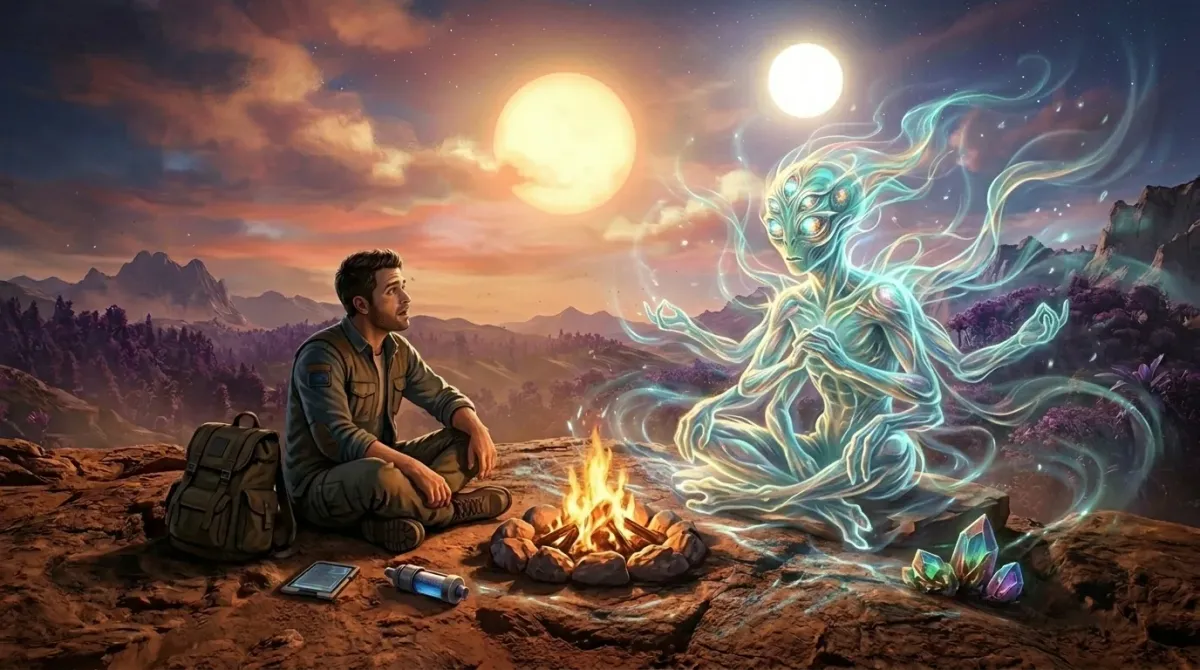
A Project Hail Mary Fan Story
Inspired by the film adaptation of Andy Weir's Project Hail Mary
Intro
Ryland Grace saved humanity once. He figured out that a microscopic alien organism was eating our sun, crossed the galaxy on a one-way trip, made friends with a spider from another star system, and solved the unsolvable. He did it alone, afraid, and half-dead most of the time.
This is not that story.
This is what happens after.
The Story
The first thing I notice is the light.
Not one sun. Three.
They're stacked in the sky at slightly different angles — one big and pale yellow, one smaller and almost white, one tiny and blue-tinged at the edge of the horizon. They cast shadows in three directions simultaneously. My shadow stretches left, backward, and faintly forward, like I'm being interrogated by geometry.
"Huh," I say out loud.
That's my second observation: I can speak. I have a mouth. I remember English. I remember that three-sun systems are called trinary systems and that they're gravitationally chaotic and statistically terrible for sustaining life-bearing planets, and yet here I am, standing on one, breathing air that smells like pine trees crossed with old library books.
Third observation: I feel great.
Not "cup of coffee after a good night's sleep" great. I mean great the way a comic book character feels great — like my legs could launch me thirty feet in the air if I asked them to, like my eyes are pulling in detail they have no business pulling in. I can read the individual ridges on a rock forty meters away. I can hear something breathing in the purple-leaved forest to my north. Something big. Multiple somethings.
Fourth observation: I have no idea how I got here.
I run the standard amnesiac-scientist checklist. Name: Ryland Grace. Occupation: former junior high school science teacher, former sole crew member of the Hail Mary, former savior of the solar system. Current situation: unknown planet, trinary star system, body apparently upgraded at some point during transit.
I sit down on a flat rock and do what I always do when I don't know something.
I start making a list.
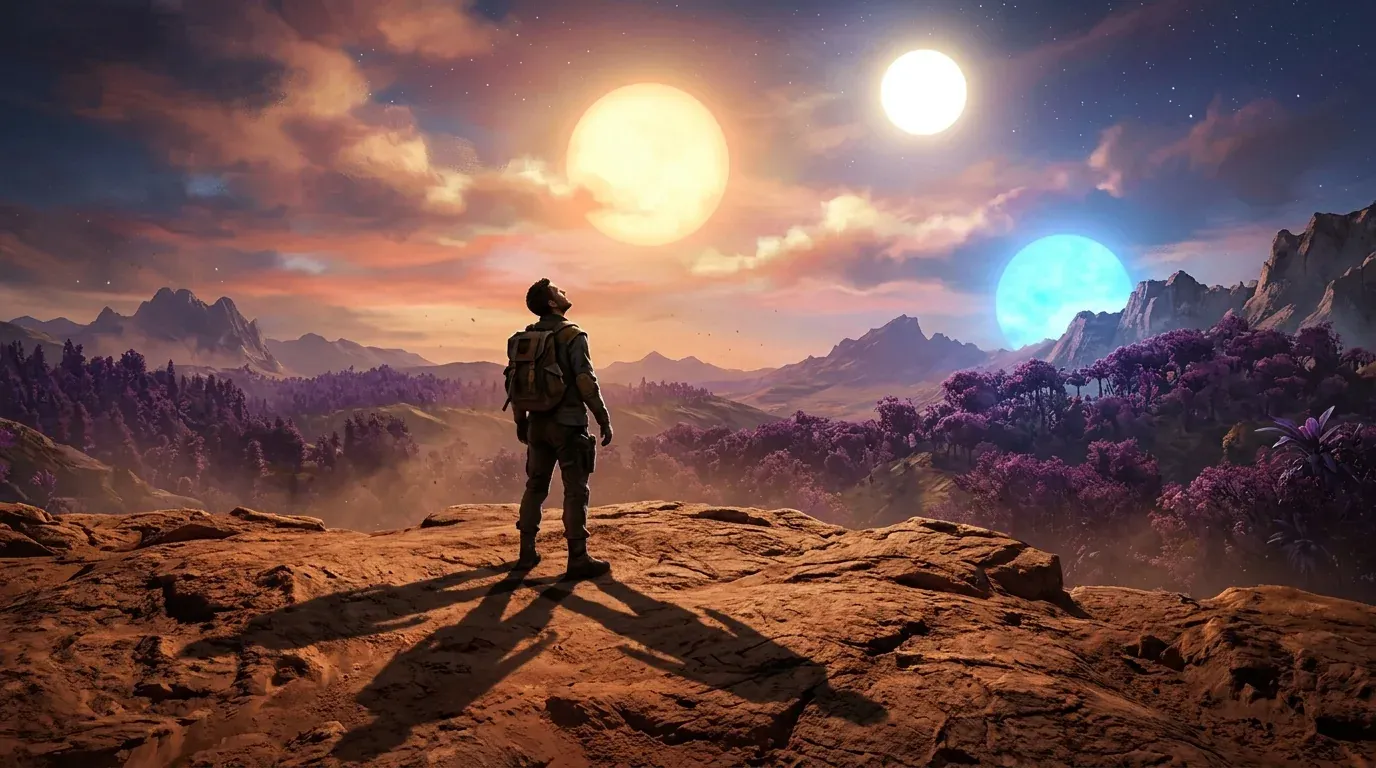
Things I Know (That I Should Not Know)
The atmosphere here is nitrogen-oxygen with a seven percent argon mix. I know that without testing it. I know the gravitational constant feels like approximately 0.91 Earth standard. I know the smaller white sun is a DA2 white dwarf approximately eleven astronomical units out. I know this immediately, the way I know my own name — not learned, just present, like someone opened a drawer in my brain that I didn't pack myself.
I stand up and look at my hands.
No scars. My left thumb has been scarred since I was nine and caught it in a bike chain. That scar is gone. The small burn mark from Rocky's first communication attempts — gone. My hands look like a stock photo of hands. Perfect, unblemished, suspiciously photogenic hands.
I lift my shirt.
Flat stomach. I work out now apparently. But that's not what I'm looking at.
I'm looking at the spot two inches below my navel.
Where my navel should be.
There's no belly button.
I stare at this for a long time. A trinary system paints three shadows across my stomach and none of them point to a navel because there is no navel.
"Okay," I say carefully. "Okay. That's a thing."
A belly button is a scar. It's the remnant of an umbilical cord. No belly button means no umbilical cord. No umbilical cord means no womb. No womb means...
I don't finish that thought yet. I file it in the Extremely Alarming folder and move on, because I am a scientist and scientists deal with data points one at a time before they catastrophize.
The forest moves.
Not in a wind-through-leaves way. In a deliberate way. The purple-leaved canopy shudders and parts and something walks out that my brain immediately categorizes as not from any evolutionary tree I know.
It's tall — about two meters — with six limbs, four of which it walks on. The upper two are held loosely at its sides like it's affecting a casual posture. Its skin is a dark greenish-grey, and its face is wide and flat with four eyes arranged in a square. It has no visible mouth.
It stops ten meters away and looks at me.
I look at it.
Then something happens inside my head that I can only describe as a knock. Like someone tapping on the inside of my skull. Politely. With the energy of someone who's done this before and is trying not to startle you.
You are the new one, something says. Not in words exactly. In meaning. The meaning arrives in my brain already assembled, like furniture that teleported past the box stage.
"I — yes?" I say out loud. "I'm Ryland. I think."
You think?
"It's been a weird morning."
The creature tilts its head. All four eyes blink in sequence, left to right. You are unfinished, it says in that same not-quite-words way. Like the others, at first. Then they remember.
"Others?" I step forward. It doesn't flinch. "There are others like me? Humans?"
Like you, yes. Not human. The ones who were made.
There it is. I feel the Extremely Alarming folder burst open.
"Made," I repeat slowly. "As in... not born."
Born is a method, it says, with the alien equivalent of a shrug. There are other methods. You were assembled from the template. It took a long time. The template was difficult — very complicated, even by the Makers' standards. They said this one thinks too much.
"That tracks," I admit.
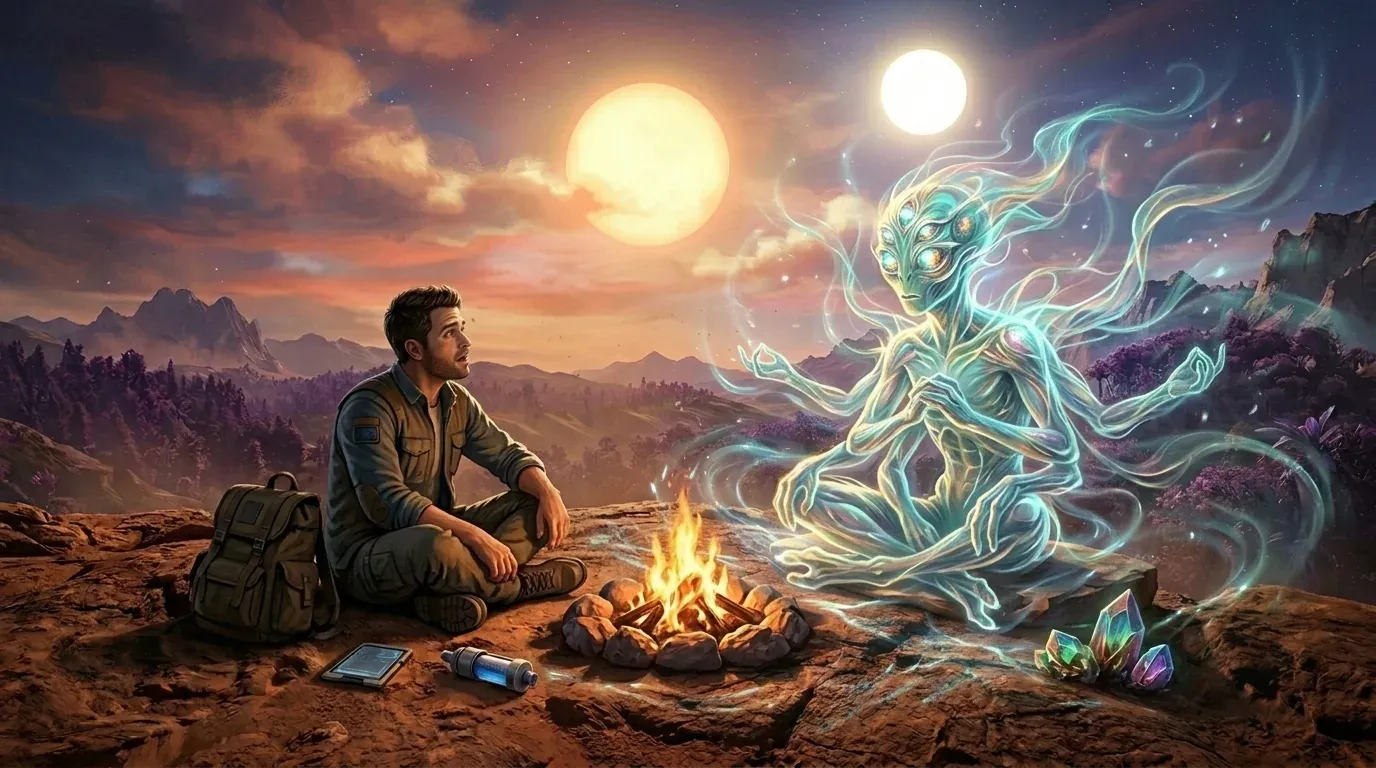
I spend the next six hours with the creature, who I mentally name Gerald because I need to call it something and it transmits its actual designation in a frequency of meaning I can't replicate. Gerald is, I come to understand, a shepherd of sorts. It tends to things. Specifically, it tends to the new ones — the assembled ones — in the early days after they wake up.
We walk through the forest. Gerald shows me things. A river that runs uphill for about thirty meters before physics reasserts itself — a geothermal quirk, I deduce, some subsurface pressure differential. I know this instantly. Gerald watches me figure it out and radiates something that feels like satisfaction.
They built the knowledge in, Gerald explains. So you would not be helpless. A mind without context is a tragedy.
"What knowledge?" I ask. "Everything? How much do I know?"
Everything you knew before. And more. The Makers filled gaps.
I stop walking. "Before. Before what?"
Gerald is quiet for a moment. In the three-sun light, its four eyes catch different colors — the yellow, the white, the faint blue — and for a second it looks almost beautiful.
Before you ended, it says simply. On the small craft. In the far system. You ended, and the signal was captured, and you were preserved, and then you were made again, here.
I sit down on a riverbank and put my face in my hands.
Rocky.
Rocky had the technology. Rocky's civilization had been doing this for thousands of years — mapping minds, transmitting consciousness, the whole works. We'd talked about it, in our tactile sign language of clicks and vibrations. I hadn't understood all of it. I'd been too focused on getting him home.
But Rocky understood me. He'd spent months studying my biology, my chemistry, my neurology. He'd mapped me the way I mapped chemical processes — meticulously, obsessively, because that's what Rocky did.
Rocky, you sneaky brilliant spider. You made a backup.
I find the first mystery that evening, sitting beside a fire I've built with skills I'm only sixty percent sure I had before.
I know things I should not know. Not just the atmospheric composition and the stellar classifications — I know solutions to problems I distinctly remember struggling with. I remember sitting in my lab, years before the Hail Mary mission, stuck on a particular protein-folding problem that had beaten better scientists than me. I remember the frustration of it.
Now I know the answer. Completely. It's just there, sitting in my head like it's always been there, like I learned it in school.
I pull at this thread.
More answers. Gaps in my original knowledge, filled in. Not just filled — filled correctly. I test them against what I know, run the logic chains, and they hold. Someone with knowledge far beyond mine went through my mental library and quietly solved the unsolved cases.
"Gerald," I say. The creature is nearby, sitting in its own version of rest, four eyes half-closed. "The Makers. Who are they?"
Old ones, it says. Not from here. From many places. They collect templates. They study them. Sometimes they improve them.
"They improved me?"
They thought you were interesting. This arrives with a warmth that suggests it's a significant compliment. A mind that solves things despite limited information. They wanted to see what you would do with more information.
This should feel violating. Someone edited my brain. Someone rifled through my thoughts and patched the holes. But I'm a scientist, and honestly, sitting here under three suns on an impossible planet with telepathy powers and perfect abs, I'm more curious than anything else.
"What do they want me to do?" I ask.
Gerald opens all four eyes. In the firelight, they look almost warm.
There is a problem, it says. A large one. The Makers have tried and failed. They thought perhaps the template who saved his own star might have a perspective they lack.
I stare into the fire. Three shadows. Somewhere up there, Rocky's civilization exists — or existed — or sent a signal once that arrived here. My friend. My first and only alien friend, who apparently thought enough of me to spend whatever resources it took to preserve me.
I'm not born. I have no navel. I'm a copy, filled in with answers to questions I never got to solve, dropped on a planet between three suns, and some ancient alien civilization wants me to fix something they can't fix.
I laugh. Actually laugh, loud enough that Gerald tilts its head at me.
"You know what?" I say. "This is fine. This is completely fine. I've done worse setups."
I poke the fire.
"Okay, Gerald. Tell me about the problem."
The knock comes inside my skull — but this time it's not just Gerald. It's something larger. Something that has been waiting, patient as geology, for exactly this moment.
And it begins to explain.
I pull out a stick and start scratching equations in the dirt.
Here we go again.
End of Part One
Comments ()