A Planet That Refused to Be Conquered

The Teratos had a saying: If a system does not want to be mapped, it is either empty or hiding something interesting.
Commander Kael Varyn had always assumed it was the latter.
The navigation error that brought them to Rathos was, according to official logs, “a statistically improbable cascade of minor failures.” According to Kael, it was bad luck wearing a lab coat. According to Dr. Soren Hal, it was destiny pretending not to be noticed.
The ship Aurelia did not glide into orbit. It limped, shuddered, and then, with all the dignity of a falling brick, entered the atmosphere at an angle that suggested it had lost interest in surviving.
“Stabilizers are gone,” said Marek, one of the three warriors, calm as ever. “Hull integrity at forty percent.”
“Forty?” muttered Drax. “Optimist.”
Vorun, the third warrior, grinned. “Relax. If we die, it will at least be memorable.”
Kael ignored them. “Divert power. Elyra?”
Dr. Elyra Sen didn’t look up from her console. “Trying. The planet is emitting… something. It’s interfering with our systems.”
“Interfering how?”
She hesitated. “As if it doesn’t want us here.”
Soren laughed softly. “Planets don’t want anything.”
“Try telling that to the one currently pulling us out of the sky,” Kael said.
The impact was less an event and more a long argument between metal and gravity. The forest below broke their fall in stages—branches, trunks, luminous vines snapping and glowing as the ship tore through them—until finally, with a sound like a closing door, everything stopped.
Silence followed.
Then the forest lit up.
Kael came back to consciousness with the unpleasant certainty that he was alive, which meant he would soon have responsibilities again.
He was lying on something soft. Not synthetic. Organic. Warm.
He opened his eyes.
The sky above him was not sky as he knew it. It shimmered in gradients of violet and deep green, as if someone had painted atmosphere with bioluminescence. Shapes moved slowly across it—massive, drifting organisms or clouds that had ambitions.
He tried to sit up.
A hand pressed him gently back down.
“You should not move,” said a voice.
It was speaking Teratos. Not perfectly, but well enough to be understood.
Kael turned his head.
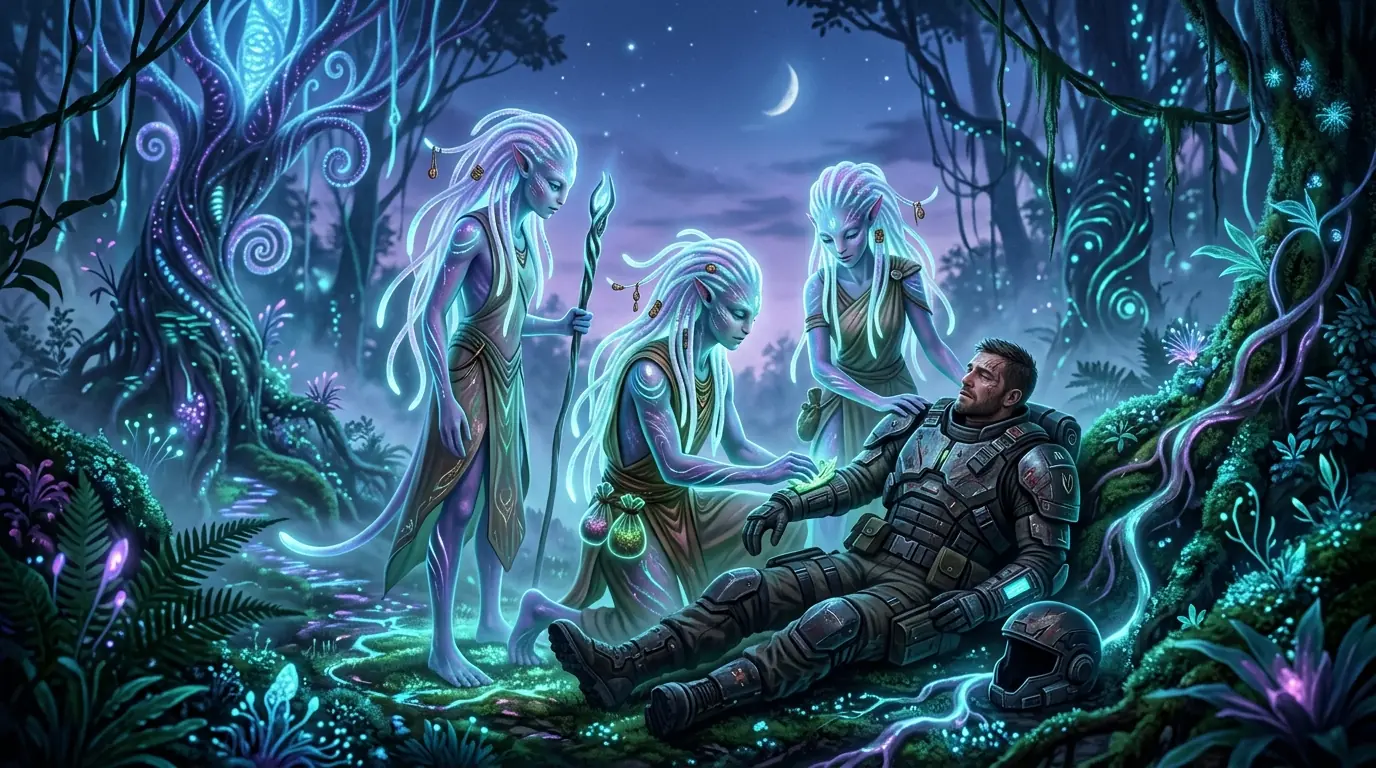
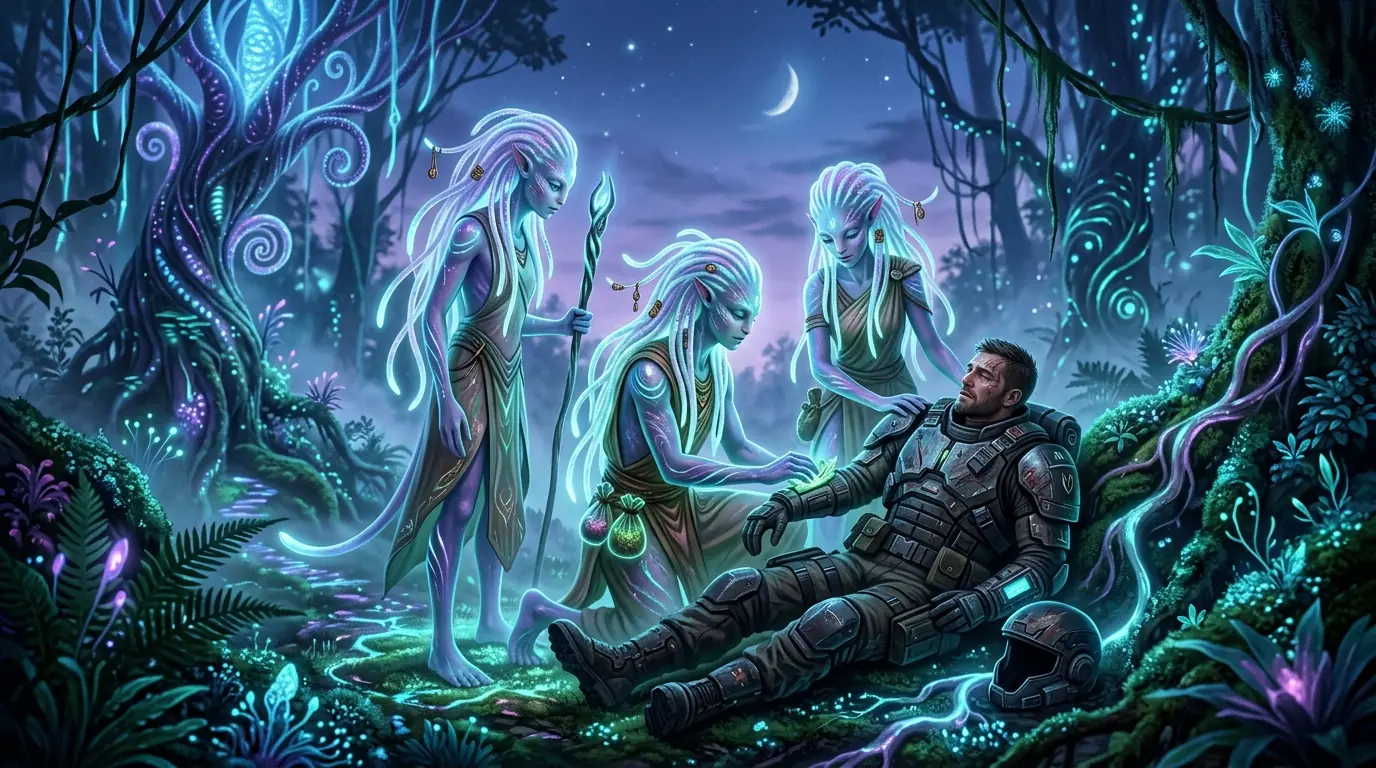
The being standing over him was not Teratos.
Her skin carried a faint glow, like light remembered rather than reflected. Patterns moved beneath it—slow, deliberate, like thoughts. Her eyes were steady and entirely unimpressed by him.
“I am Tala,” she said. “You fell. You would have died. You did not.”
Kael processed this. “Because of you?”
“Yes.”
“That was considerate.”
“We are sometimes considerate,” she said.
Two others stood behind her. One broad and watchful—Ruun. The other younger, curious—Mira, whose gaze flickered over Kael as though he were both a puzzle and a warning.
“My crew?” Kael asked.
“Scattered,” Tala said. “Alive. We are collecting them.”
Kael nodded, then allowed himself to relax. “Then I suppose I owe you something.”
Tala tilted her head slightly. “Yes,” she said. “But we will discover what that is later.”
The Teratos prided themselves on adaptability. It was one of the things they mentioned in official reports, just after “technological superiority” and just before “cultural flexibility,” which was usually a polite way of saying we can pretend to respect you while studying your weaknesses.
On Rathos, adaptability was tested immediately.
The Rasta—so they called themselves—had no visible machines. No metal. No cities in the Teratos sense. And yet they navigated the forest with precision, communicated over distances without devices, and healed injuries that should have required advanced intervention.
Elyra was fascinated.
“This isn’t primitive,” she told Kael as they watched Mira coax a fractured support beam to shift using nothing but touch and some form of resonance. “It’s… parallel development. They’ve solved problems differently.”
Soren stood nearby, arms folded. “They’ve skipped the inefficient stages. No industry. No infrastructure. Straight to… whatever this is.”
“And you don’t find that remarkable?” Elyra asked.
“I find it useful,” Soren said.
Kael filed that tone away for later.
The first formal exchange of knowledge took place three days after the crash, once all Teratos personnel were accounted for and no one was actively bleeding.
They sat in a clearing that seemed designed for the purpose, though Tala insisted it had “always been there.”
Kael explained the basics of Teratos technology—carefully simplified. Marek demonstrated non-lethal defensive techniques. Elyra shared data interfaces, projecting harmless simulations into the air.
In return, the Rasta showed them how to listen.
This, at first, seemed disappointing.
“You want us to… sit?” Drax asked.
“Yes,” Mira said.
“And do nothing?”
“Yes.”
Drax looked at Kael. “I preferred the part where we explained weapons.”
“Try it,” Kael said.
So they sat.
At first, there was only the forest—sound, light, movement. Then, gradually, patterns emerged. Rhythms. Pulses. A kind of communication that wasn’t language but wasn’t random either.
Elyra felt it first.
“It’s structured,” she whispered. “There’s information here.”
Soren leaned forward, suddenly interested. “A network.”
Tala nodded. “You begin to hear.”
Kael closed his eyes.
For a moment—just a moment—he felt something vast and patient brush against his awareness, like the edge of an ocean touching shore.
He opened his eyes again.
“We will need more time,” he said.
“You will need more than time,” Tala replied.
The discovery of the Heart of Rathos was, like most important discoveries, an accident followed by a bad decision.
The accident was Mira’s curiosity.
“You do not understand us,” she told Elyra one evening. “Not yet. You see parts.”
“That’s how understanding works,” Elyra said. “In parts.”
Mira shook her head. “Then you should see the whole.”
She led Elyra deep into the forest, beyond where the Teratos had been permitted to wander. Elyra hesitated only briefly before following.
The bad decision was Vorun’s habit of not respecting boundaries.
He followed them.
Not openly. Not carelessly. Vorun was many things, but incompetent was not among them. He moved through the forest like a shadow with intent.
When they reached the clearing, even he stopped.
The Heart of Rathos was not subtle.
Crystalline structures rose from the ground, massive and irregular, glowing with a light that seemed to come from inside reality itself. Energy moved between them in arcs and currents, like lightning that had learned patience.
Mira stepped forward and placed her hand on one of the crystals.
The world responded.
The light intensified. The forest around them shifted, aligning, listening.
Elyra felt it again—stronger now. Not just presence, but attention.
“What is this?” she breathed.
“The Heart,” Mira said. “It is Rathos.”
Elyra’s mind raced. “A planetary neural network… a distributed consciousness… this is—”
“Alive,” Mira said simply.
Behind them, unseen, Vorun smiled.
By the time the argument began, it was already too late to avoid.
Soren listened to Vorun’s report without interrupting. That alone made Elyra uneasy when she learned of it later.
“Show me,” Soren said.
Vorun nodded. “I thought you’d say that.”
They brought Kael in after.
“This changes everything,” Soren said, pacing. “We are looking at a conscious energy system integrated into a planetary biosphere. The applications—”
“Are not ours,” Elyra said.
“Everything is ours if we can understand it,” Soren replied.
Kael raised a hand. “We are not here to take.”
Vorun leaned against the wall. “We didn’t come here at all. We crashed. That makes this… opportunity.”
Marek’s expression hardened. “They saved us.”
“And we thanked them,” Vorun said. “Extensively. I’m sure they feel appreciated.”
Drax snorted despite himself.
Elyra stepped closer to Soren. “You’ve seen what it does. It’s not just energy. It’s… aware.”
“All the better,” Soren said. “Adaptive systems are more efficient.”
“You’re talking about cutting into a living mind.”
“I’m talking about interfacing with it.”
Kael’s voice was quiet. “No.”
Soren stopped pacing. “No?”
“No,” Kael repeated. “We repair the ship. We leave.”
Vorun straightened. “I don’t.”
Silence.
“You don’t what?” Marek asked.
“I don’t leave without it,” Vorun said.
Kael met his gaze. “Then you don’t leave with us.”
For a moment, it seemed that might be the end of it.
It wasn’t.
Betrayal, when it comes, is rarely dramatic at first. It is procedural.
Systems go offline.
Communications fail.
Doors refuse to open.
By the time Kael realized what was happening, Vorun and Soren had already moved.
“They’ve taken a team,” Drax reported. “Small. Loyal.”
Marek checked his weapon. “Destination?”
Kael didn’t need to answer.
“The Heart,” Elyra said.
Tala was waiting for them.
Of course she was.
“You knew,” Kael said.
“We listened,” Tala replied. “You speak loudly, even when you think you are silent.”
“They intend to take the Heart.”
“Yes.”
Kael looked past her, toward the deeper forest. “Can you stop them?”
Tala considered this. “We can try,” she said. “But it will not be without cost.”
Marek stepped forward. “Then we go.”
Ruun nodded once, approving.
Mira looked at Elyra. “You must speak to him,” she said. “The one who thinks he understands.”
“I will,” Elyra said. “I just hope he listens.”
Mira’s expression was almost amused. “He will,” she said. “Eventually.”
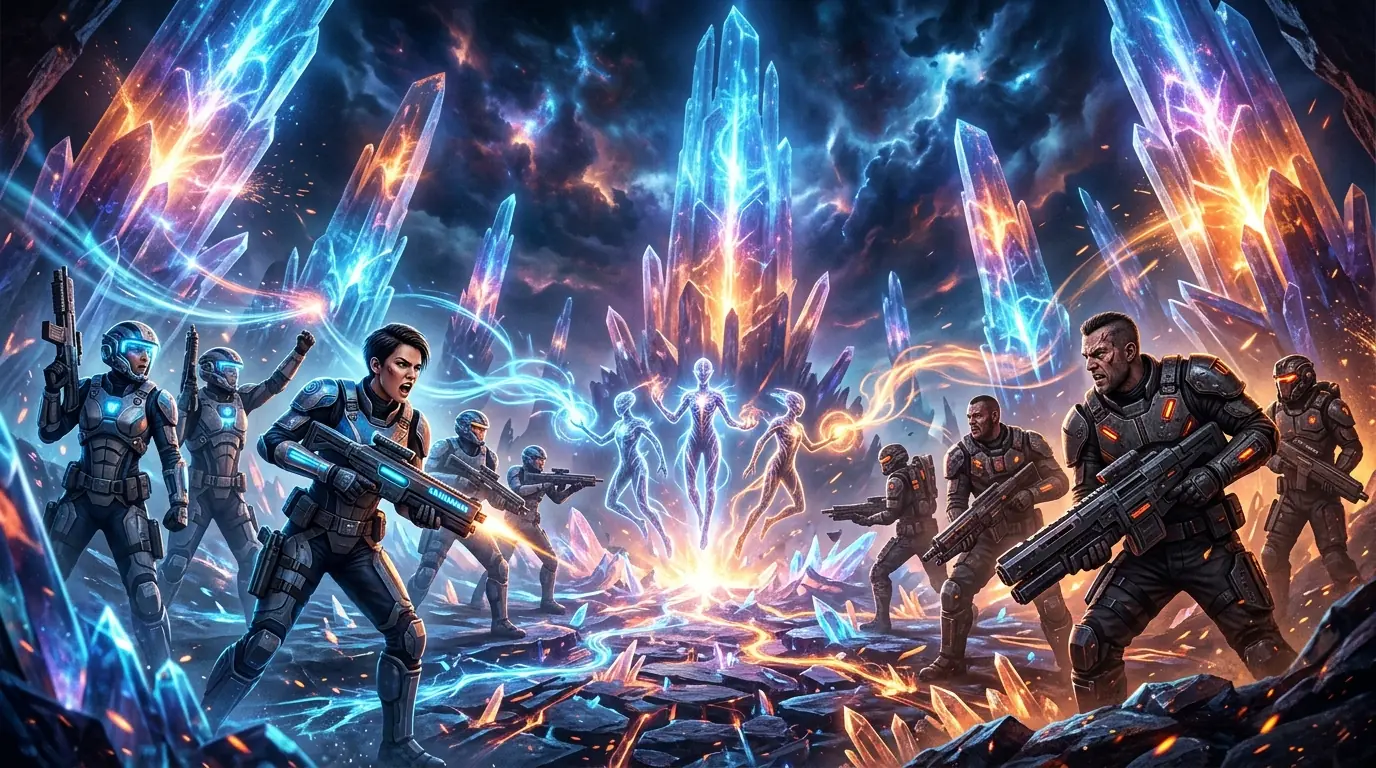
The confrontation at the Heart of Rathos was not, in the traditional sense, a battle.
It was an argument conducted with weapons, energy, and the occasional collapse of local reality.
Soren had already begun.
A device—improvised, elegant, and deeply offensive to everything Elyra believed in—was connected to one of the crystals. It hummed with contained ambition.
Vorun stood guard.
“You’re late,” he said as Kael and the others entered the clearing.
“Stop this,” Kael said.
Soren didn’t turn. “No.”
“That’s not a negotiation,” Kael said.
“It wasn’t meant to be.”
Energy began to build.
The crystals responded—not passively, but defensively. Light surged, patterns shifting from harmony to something sharper.
“You’re hurting it,” Elyra said.
“I’m waking it up,” Soren replied.
Mira stepped forward. “You do not wake the Heart,” she said. “It is always awake.”
Vorun raised his weapon. “Stay back.”
Ruun didn’t stay back.
The clash between him and Marek was immediate and precise—two warriors testing each other without hatred but with full commitment. Drax moved to support, intercepting one of Vorun’s allies.
Kael advanced on Vorun.
“This ends now,” Kael said.
“It begins now,” Vorun replied, and attacked.
Their fight was brutal and efficient. They knew each other too well for theatrics. Every move was anticipated, countered, adapted.
Nearby, Elyra reached Soren.
“Shut it down,” she said.
“Not yet.”
“You’re destabilizing the entire system.”
“I’m mapping it.”
“You’re killing it.”
Soren finally turned. “It’s a system, Elyra. Systems can be rebuilt.”
“Not this one.”
Behind them, the Heart reacted.
The ground trembled. Light fractured into sharp, erratic bursts. The forest beyond the clearing shifted, as if something vast were turning in its sleep.
Mira closed her eyes and reached out—not with hands, but with whatever it was the Rasta used instead.
Tala joined her. Then others.
They formed a circle, not around the device, but around the disturbance.
“They’re stabilizing it,” Elyra realized.
“Temporarily,” Soren said. “They can’t hold it if I push further.”
“Why are you doing this?” Elyra asked.
Soren’s expression was calm. “Because we can’t afford not to.”
“For power?”
“For survival,” he said. “You think the Teratos remain at the top by leaving miracles untouched?”
“I think we remain ourselves by choosing what not to take.”
Soren smiled faintly. “That’s very poetic. And completely impractical.”
The device surged.
Something broke.
Not physically. Not entirely. But something fundamental shifted, and for a moment, everyone felt it.
The Heart was no longer just reacting.
It was responding.
Kael saw the opening.
Vorun overextended—just slightly, just enough. Kael disarmed him with a precise strike and forced him to the ground.
“It’s over,” Kael said.
Vorun laughed, even pinned. “Look around.”
Kael did.
The clearing was chaos. Light and energy spiraled, the crystals pulsing in unstable rhythms. The Rasta strained to maintain balance. Soren stood at the center of it all, the device glowing with dangerous intensity.
“It’s not over,” Vorun said. “It’s inevitable.”
Kael tightened his grip. “No,” he said. “It isn’t.”
Elyra made a decision.
It was not a calculated one. It did not come from training or protocol.
It came from listening.
She stepped past Soren and placed her hand on the crystal.
For a moment, nothing happened.
Then everything did.
The world opened.
Not visually. Not physically. But perceptually.
She felt Rathos—not as a planet, but as a presence vast beyond comprehension. Not hostile. Not friendly. Simply… aware.
You are loud, it seemed to say.
“I know,” Elyra whispered.
You are breaking things.
“I know.”
Why?
Elyra glanced back at Soren. “Because we’re afraid,” she said.
There was a pause.
Of what?
“Of not being in control.”
Another pause.
Then, unexpectedly:
That is reasonable.
Elyra almost laughed.
“Can you stop this?” she asked.
Yes.
“Will you?”
If you ask properly.
Elyra closed her eyes. “Please.”
The response was immediate.
The energy stabilized—not by force, but by rebalancing. The violent surges smoothed into steady flows. The device in Soren’s hands flickered, then shut down entirely.
He stared at it. “What did you do?”
Elyra removed her hand. “I asked.”
The aftermath was quiet.
Vorun and Soren were restrained—not violently, but firmly. Their remaining allies surrendered without further resistance.
The Heart of Rathos returned to its steady, patient rhythm.
Tala approached Kael. “It is finished?”
“Yes,” Kael said.
She looked at Vorun and Soren. “No,” she said. “It is understood.”
Later, aboard the partially repaired Aurelia, the full extent of the betrayal became clear. Soren had planned to extract not just data, but a core fragment of the Heart—enough to replicate its properties elsewhere.
“It would have killed the system,” Elyra said.
“It would have changed everything,” Soren replied.
Kael shook his head. “It would have ended us,” he said.
Vorun said nothing. For the first time since Kael had known him, he seemed uncertain.
The decision was made collectively.
The Teratos who had followed Vorun and Soren were divided—some out of ambition, some out of fear, some simply because they had trusted the wrong voices.
“They will return with us,” Kael said. “And they will answer for what they’ve done.”
“And Rathos?” Elyra asked.
Kael looked out at the glowing forest below.
“We leave it alone.”
Departure was less dramatic than arrival.
No storms. No crashes. Just a slow ascent through an atmosphere that now felt… aware of them.
Tala, Mira, and Ruun stood at the edge of the clearing as the ship lifted.
“You have changed,” Tala had said to Kael before he left.
“So have you,” he replied.
She had smiled slightly. “We always do,” she said. “Just more slowly.”
Mira had looked at Elyra. “You listened,” she said.
“I tried,” Elyra replied.
“That is the same thing,” Mira said.
As Rathos shrank beneath them, Kael allowed himself a rare moment of reflection.
“We could have taken it,” Drax said quietly beside him.
“Yes,” Kael said.
“We didn’t.”
“No.”
Drax nodded. “Strange.”
Kael almost smiled. “Not as strange as it should be.”
Elyra joined them, watching the planet fade into the distance.
“It’s still there,” she said. “Unchanged.”
Kael shook his head. “No,” he said. “Not unchanged.”
Below, the Heart of Rathos pulsed—steady, aware.
And somewhere within it, perhaps, was the faint echo of a conversation.