Mad Honey (The Ants’ Warning)
On a lunar research base, young exobiologist Melon Usk studies ant colonies shipped to the Moon. Colonies A and B are collapsing into violence and cannibalism, while the unremarkable Colony C quietly builds intricate, repeating structures that look like patterns

Short Summary:
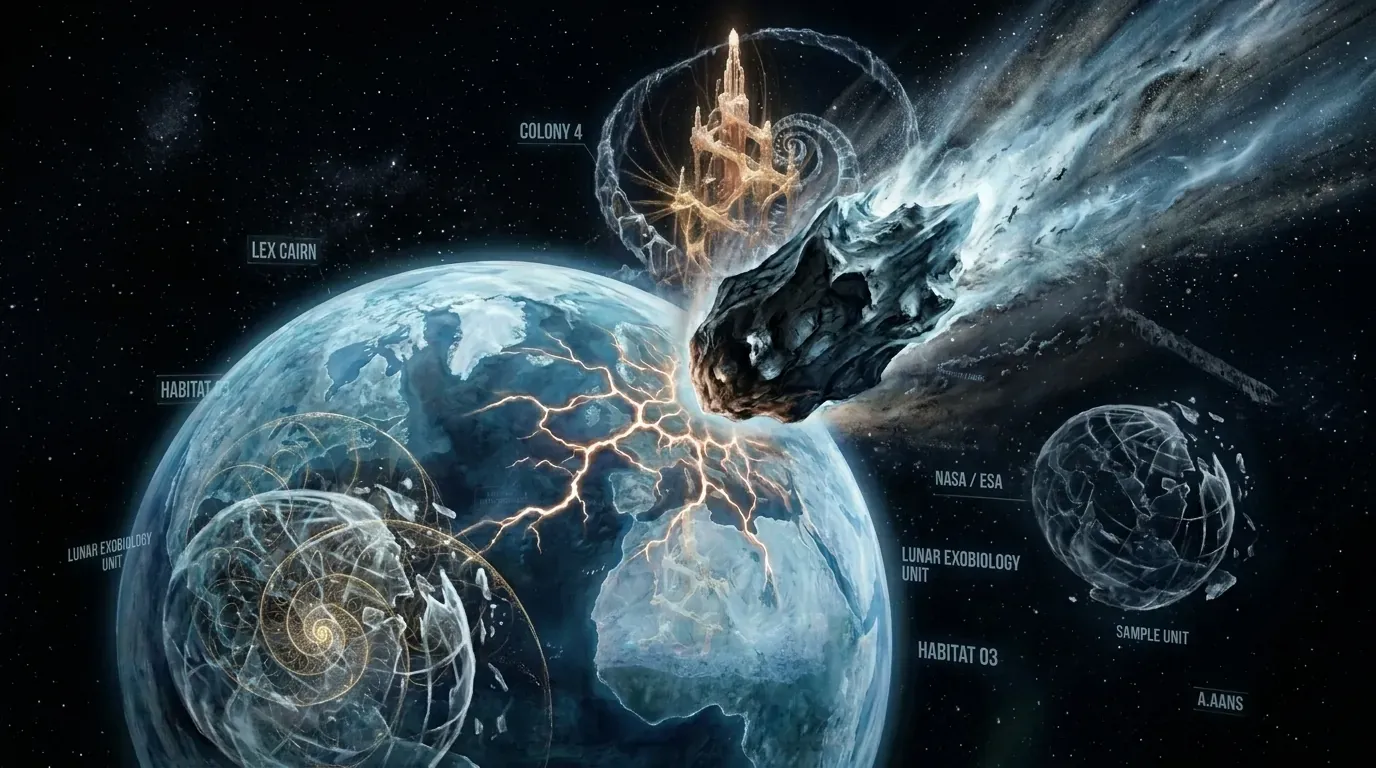
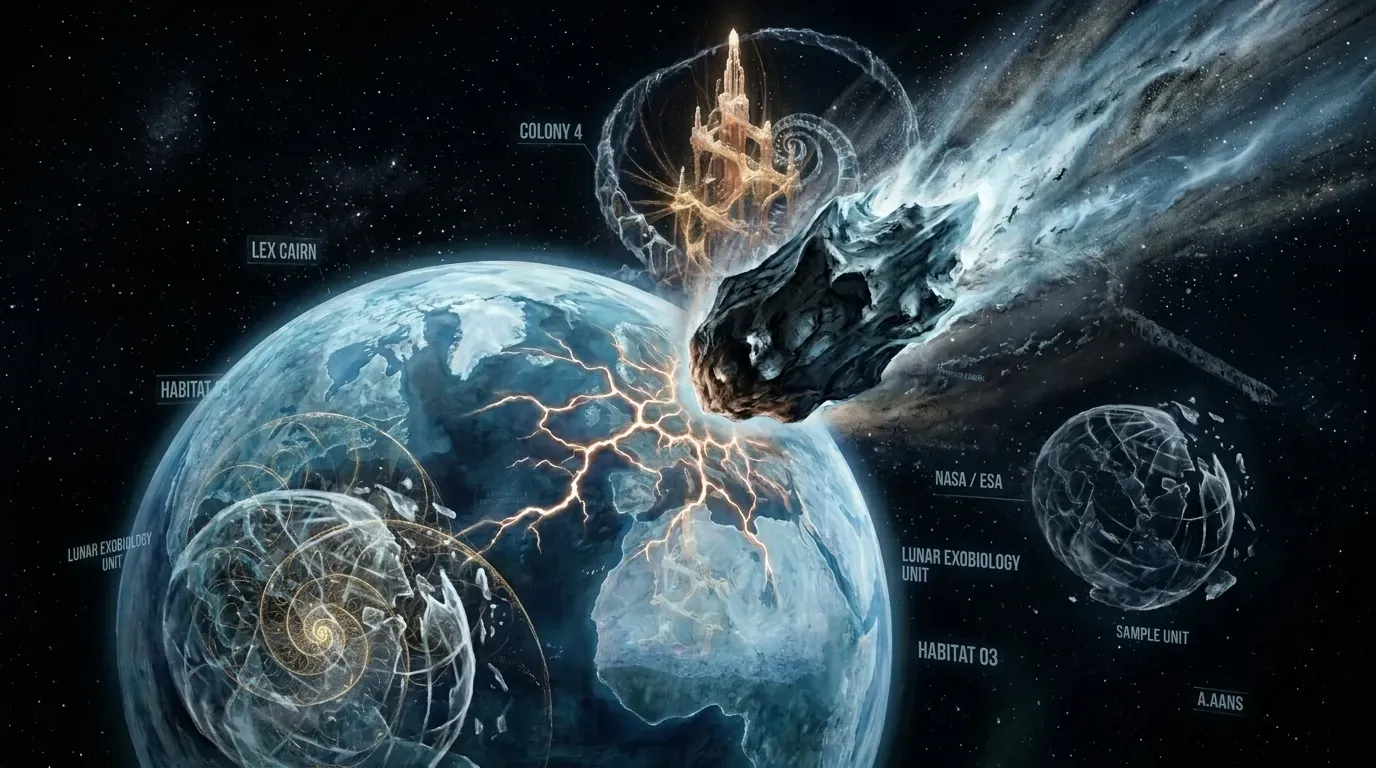
On a lunar research base, young exobiologist Melon Usk studies ant colonies shipped to the Moon. Colonies A and B are collapsing into violence and cannibalism, while the unremarkable Colony C quietly builds intricate, repeating structures that look like patterns — a cracked globe, a tower, a spiral. When Melon discovers that Colony C cultivates a psychotropic “mad honey,” he tastes it and experiences a vivid vision: a large asteroid on a collision course with Earth. He realizes the ants have been using the honey and their structures to warn humanity of the impending impact.
Lead researcher Jeremy Voss dismisses the idea as drug-induced delusion, but Melon, psychologist Maya, and animal behavior specialist Linda work in secret to document the ant messages. They transmit their data to Earth just as Jeremy attempts to shut them down. Earth-based astronomers confirm the trajectory: a dark comet fragment is indeed heading for a catastrophic impact. The world scrambles to mount a deflection mission while the ants continue building new, hopeful shapes. The ending remains open—the comet’s fate uncertain—but the ants’ quiet, interspecies warning has finally been heard.
Characters:
- Melon Usk – Young, smart, open-minded exobiologist. He is the first to truly “hear” the ants’ warning after ingesting the honey, and becomes the driving force behind revealing the message.
- Maya – The base’s psychologist and Melon’s partner in the investigation. Calm, perceptive, and brave; she supports him both emotionally and scientifically, even experiencing a touch of the vision herself.
- Jeremy Voss – The lead researcher, older and stubbornly old-fashioned. He rigidly denies any possibility of insect intelligence or symbolic communication, dismissing the ants’ behavior as random and the honey as a dangerous hallucinogen.
- Linda – A petite, blonde animal behavior specialist with a gentle heart. She is the first to analyze the ants’ psychotropic honeydew and secretly aids Melon, often driven to tears by the violence among the colonies.
- Ant Colony A and B – Aggressive Formica sanguinea colonies that have devolved into constant fighting, cannibalism, and fragmentation. They represent blind panic and destruction under stress.
- Ant Colony C – A peaceful Lasius neglectus colony that cultivates the honey-producing fungus and builds the cryptic warning structures. It is the only colony communicating coherently.
- Chen (minor) – The base communications technician who helps transmit the warning data to Earth.
Chapter 1: Mad Honey
The moon base hummed with the quiet desperation of machinery that had been serviced one time too many. In the exobiology wing, sealed behind three separate pressure doors, Melon Usk was watching ants fight.
He’d been watching them for six months now—ever since the International Entomological Initiative had shipped forty-seven micro-colonies to the Moon, hoping to crack the puzzle of social insects in low gravity. The results had been a disaster. Colonies A and B, both Formica sanguinea strains genetically optimized for hardiness, had devolved into cannibalistic gangs. Instead of expanding their queens’ broods, they’d splintered into feuding sub-nests, each barely the size of a thumbnail. Workers from A would raid B’s fungus gardens and return with nothing but severed antennae clamped in their mandibles. B retaliated by dragging pupae into the open and leaving them to desiccate under the UV lamps. Both colonies shrank weekly. Both attacked anything that moved.
And then there was Colony C.
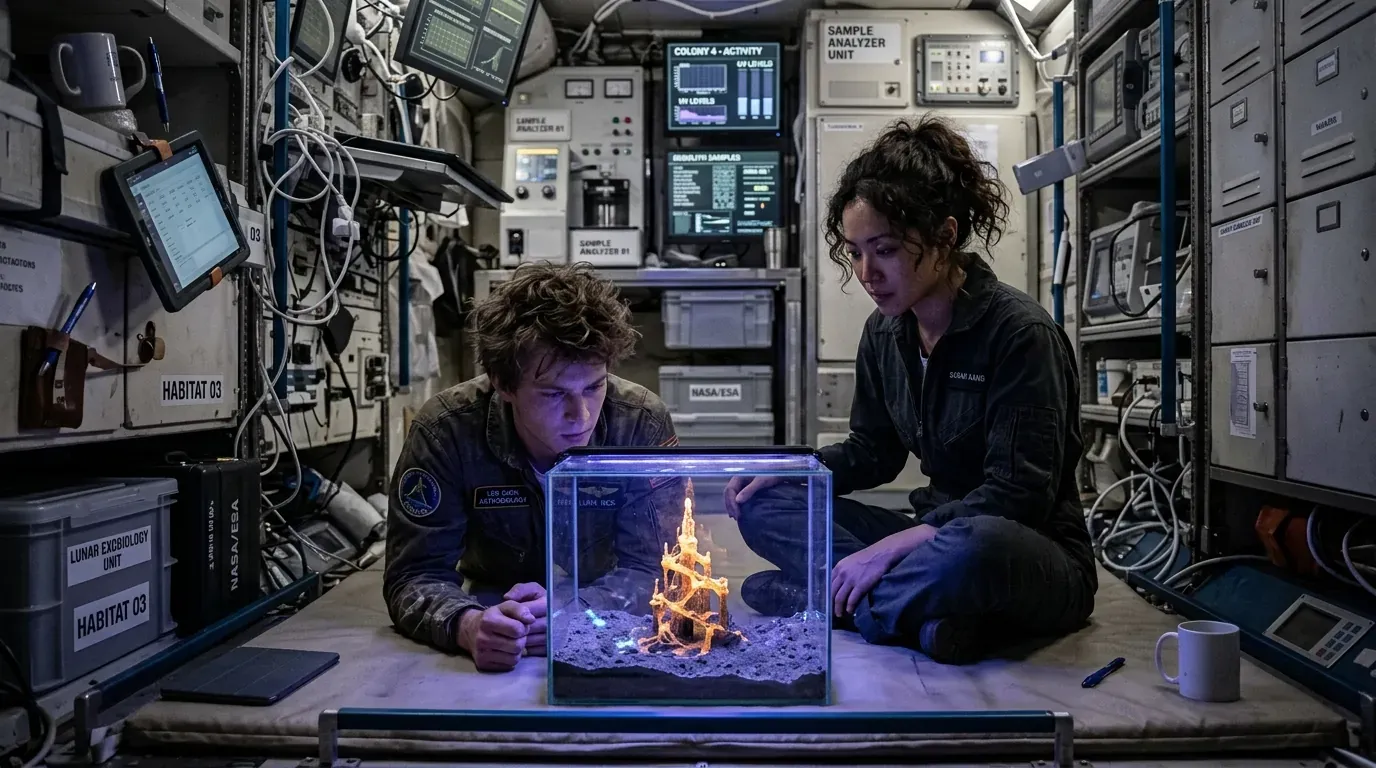
Lasius neglectus, the invasive garden ant nobody had wanted to send. Some bureaucrat on Earth had thrown them in as a control group, then forgotten to label the crate properly. They should have died first. Instead, they’d built a quiet cathedral of lunar regolith dust, glued together with a strange, amber-tinted secretion that glistened like pine sap under the lights. They avoided fights. They grew. Slowly, carefully, they assembled tiny, intricate shapes on the floor of their enclosure—hexagons, spirals, what looked like a minuscule Tower of Babel that rose three centimeters high before a raid from Colony A smashed it flat.
Melon lay on his stomach, chin on his fists, staring into the enclosure. The tiny structures pulled at his thoughts in a way that made no scientific sense. He’d tried photographing them, and the images had somehow failed to capture the weird precision. It was like looking at writing in a language you almost remembered from a dream.
“You’re going to get back cramps again,” Maya said. She’d come in silently, as she always did, her psychologist’s soft-soled shoes making no sound on the metal grating. She settled cross-legged beside him, her dark hair drifting in the low lunar gravity. “Jeremy’s been looking for you. He wants the quarterly behavior report by tomorrow, and Linda’s been crying again.”
“Linda cries every time they kill a pupa,” Melon murmured. “Which is roughly every three hours.”
“You know, she’s the animal behavior specialist. You’d think she’d have more distance.”
“I admire her for caring.” Melon pointed. “Look. Colony C rebuilt the tower. After last night’s raid. Same spot, same pattern. They’ve started before the corpse pile dries out.”
Maya leaned closer. The structure was no larger than a match head, but its geometric precision was eerie. Tiny arches. A central pillar. Seven radial spokes that didn’t seem to correspond to any known ant nest architecture.
“It looks like a signal,” she said quietly.
Melon’s heart thumped. He’d never said that aloud. Maya, the psychologist, with her training in pattern recognition and human delusion, had just said it without prompting.
A sharp voice cracked from the doorway. “A signal? Don’t be absurd.”
Jeremy—the lead researcher, Jeremy Voss—stood with his arms folded, his silver beard bristling. He had the weary condescension of a man who’d spent thirty years proving insects operated purely on instinct and resented any suggestion to the contrary.
“They’re stressed, building chaos structures. Low gravity disrupts their proprioception, you know that, Usk. They pile things randomly, and your pattern-hungry primate brain sees meaning. It’s apophenia. Write it in the report.”
He left before Melon could argue. Melon had learned not to argue with Jeremy. The man’s scientific certainty was a castle with no doors.
Maya squeezed Melon’s arm. “You’re not crazy.”
“I might be.” He smiled crookedly. “But I’m going to prove it one way or another.”
The breakthrough came three days later, and it came from Linda.
She burst into the common room, blonde curls bouncing, eyes red from recent crying but bright with excitement. She clutched a small glass vial containing a bead of amber liquid.
“They’re making honey! Colony C is making some kind of honeydew! It’s not from aphids—there are no aphids here—it’s a secretion from a modified fungus they’re cultivating in the dark corner of their nest. The chemical analysis is insane. It’s full of compounds I’ve never seen, some that share signatures with grayanotoxins, like the stuff in mad honey back on Earth. You know, from rhododendron nectar? It causes hallucinations in humans, dizziness, even—”
“Slow down,” Melon said, taking the vial carefully. The liquid caught the light like liquid amber, like a trapped sunset. “You’re saying the ants are farming a psychotropic fungus?”
“Yes! And they feed on it. Watch this.” Linda pulled up a tablet, showing infrared footage from inside the C enclosure. Workers clustered around a pale fungal mat, their antennae trembling in what looked like ecstasy. After feeding, they moved with a different rhythm, more purposeful, more coordinated. They immediately began construction on a new shape, this one a perfect hemisphere with a crack radiating from its center.
Melon’s skin prickled.
“Have you tested it on a human?” he asked.
Linda’s eyes widened. “Jeremy would kill us. We’re not even supposed to bring biological unknowns out of the sealed lab.”
Melon stared at the tiny hemisphere. A globe with a crack. A shattering world.
“I’m going to try it,” he said.
Maya, who’d been listening from the doorway, stepped forward. “Melon, no. We don’t know the toxicity. Let’s at least run more spectro—”
“Jeremy will quarantine it the second he reads Linda’s report. He’ll say it’s a contamination threat and incinerate Colony C. We both know that. This is our window.”
Maya’s jaw tightened. Then she nodded slowly. “Then I’m staying with you. You don’t go into a hallucinogenic state without a sitter. That’s basic protocol.”
Linda looked between them, frightened but determined. “I’ll monitor vitals. And I’ll... I’ll distract Jeremy if he comes snooping.”
They did it in Melon’s cramped quarters, lights dimmed, a med-kit open on the desk. Melon touched the tip of his finger to the amber droplet and placed it on his tongue.
It tasted of earth and metal, of something ancient and green. Then the world shattered.
He was falling. No—flying. He was a speck of dust in a vast cosmic wind, and around him, impossibly large, spun the blue-green marble of Earth. It was so beautiful it hurt. He could see the swirl of clouds, the glitter of cities on the night side, the thin, fragile scrim of atmosphere.
And then he saw the shadow.
A dark, tumbling shape, wreathed in ice and rock, arcing across the solar system. Its trajectory was a line of silver fire in his mind, and it intersected Earth in a blossoming rose of destruction. The crack in the globe. The impact. The fire. The silence after.
He heard a sound, a high-frequency keening that resolved into... words? Not words. Images. Sensations. A message, carved in ant-language, built in towers and spirals and cracked hemispheres.
We see the sky. We feel the vibration. It comes. Warn the giants. Warn the giants. Warn the giants.
When Melon opened his eyes, he was lying on the floor, Maya’s hands on his face, Linda’s terrified voice calling his name. His cheeks were wet. His hands were shaking.
“I saw it,” he croaked. “I saw what they’re trying to tell us. They’re sensing a gravitational anomaly or seismic precursor waves, something their antennae can feel. There’s a rock coming. A big one. And they’ve been trying to build the warning for months.”
Maya’s face was pale. “A rock? You mean an asteroid? Melon, that’s... that’s huge. We have to tell Earth, tell the agencies.”
“Jeremy first,” Melon said, struggling upright. “He’s the lead. If we bypass him, no one will listen. We need his authority.”
They found Jeremy in the main lab, hunched over spectrographs of Colony A’s aggression pheromones. He didn’t look up when they entered.
“Sir,” Melon began, “Colony C is producing a psychotropic honeydew. I’ve ingested a microdose and experienced a coherent vision of an asteroid impact. The ants’ building patterns correspond to impact trajectories and damage maps. I believe they’re trying to communicate a warning.”
Jeremy set down his stylus with exaggerated slowness. He turned, looked at Melon’s sweat-damp hair, at Maya’s tight expression, at Linda who flinched behind them.
“You ingested an unknown biological substance from an ant colony,” he said flatly. “Without authorization. Without safety protocols. You then experienced a hallucination—the expected result of a neurotoxin—and you’re interpreting it as an interstellar warning from insects.” He stood up, his voice rising. “This is a textbook psychotic break, Usk. Stress, isolation, low gravity, and now self-administered poisoning. You’re off the project. All of you. Linda, you’re confined to quarters for enabling this. Maya, I expected better.”
“Jeremy, listen to me,” Maya said, her voice calm but firm. “The patterns in Colony C are reproducible. We have weeks of footage showing them rebuilding the same warning shapes even after they’re destroyed. The honey isn’t random. It’s a tool. They’ve evolved it as a communication vector, maybe because they knew direct signaling wouldn’t work. This isn’t madness.”
“It is exactly madness.” Jeremy’s eyes were hard. “I’ve seen this before—researchers going native, anthropomorphizing their subjects until they lose all objectivity. Ants do not warn people. Ants do not possess abstract symbol systems. Ants do not predict asteroid impacts. You’ve all been too long in the bubble. We’re shipping Colony C back to Earth for incineration and starting a full psychological review of this team.”
He strode to the wall comm.
And that was when the first alarm sounded.
Chapter 2: Ants in Space
It wasn’t an impact alarm. It was a proximity alert—a supply drone from Earth had gone off-course and would pass dangerously close to the base’s orbit. Emergency protocols kicked in. The base went into lockdown. Jeremy was diverted, red-faced and furious, into crisis management.
Melon, Maya, and Linda were not confined. Not yet. The chaos bought them time, and they used every second.
They gathered in the exobiology wing, sealed the door, and brought up every piece of data they had on Colony C. Linda had been keeping a secret log, months of observations that she’d been too nervous to share with Jeremy: the structures weren’t random. They followed a sequence. Hemisphere-crack. Radiating lines. A series of dots in concentric orbits. Then the tower with seven spokes. Then a spiral that, when viewed from above, matched the Fibonacci sequence and the orbital pattern of a near-Earth object.
“Look at this,” Melon said, pulling up astronomical databases on his tablet. He overlaid the ants’ construction sequence with the Minor Planet Center’s trajectory logs. “There’s a cluster of asteroids in the Apollo group that hasn’t been tracked properly for six months. Last known orbital elements are fuzzy. But if you take the ant pattern as a projection model, it resolves into a single object. About 1.2 kilometers wide. Orbital period 2.3 years. Next close approach...” He paused, running the calculation. “Eight months from now. And the error bar puts it on a direct collision vector with Earth.”
Maya stared at the screen. “One point two kilometers. That’s... that’s a continent killer. Not an extinction event, but enough to collapse global agriculture, trigger tsunamis, kill billions.”
“Why would ants on the Moon know this before we do?” Linda whispered.
Melon thought of the honey, the tremor in his bones, the vision of space. “Their antennae are seismic detectors. Maybe they’re feeling gravitational resonances we can’t measure. Maybe the fungus transforms some quantum or magnetic field fluctuation into a sensation they can interpret. I don’t know. But the message is real.”
“We have to get this to Earth,” Maya said. “Jeremy won’t listen, but if we can reach an astronomer, someone with authority...”
“The comms are monitored. All official channels go through Jeremy’s clearance.” Melon chewed his lip. “We need evidence so overwhelming that no one can dismiss it. We need to show them that the ants are doing this deliberately, that the honey is not a toxin but a translation tool. We need to give the honey to someone on Earth and have them see the vision.”
Linda shook her head. “The honey degrades outside the fungal matrix. I’ve been trying to synthesize it, but it’s incredibly unstable. It’s like it’s designed to be used fresh, in the colony. It’s meant for immediate, local communication.”
“Then we need to bring the ants to Earth,” Maya said simply. “Or bring Earth here, in a way they can’t ignore.”
They worked through the night, while the base hummed with the supply-drone emergency. Linda fed Colony C nutrient gels and protected them from a raid by Colony A, which had been growing more aggressive by the hour. The ants were terrified—Melon could feel it now, a low-grade hum at the edge of his perception that the honey had unlocked, like a radio station tuned almost to static. Something was coming, and they knew it, and their desperation was turning them violent. Colonies A and B were beyond reason, their queens dead, their workers mad with fear. Only Colony C, quiet and purposeful, kept building their towers and their cracked worlds.
By morning, Melon had a plan. It was barely a plan—more a desperate gamble—but it was something.
“I’m going to take a larger dose of the honey,” he said. “Enough to sustain a long-duration vision. You’re going to record everything I say, every movement I make, every drawing I scratch on the floor. We’ll create a data package—neural scans, vocal transcripts, video, the ant structures, the orbital math—and we’ll bypass Jeremy. Linda, you know the comms technician, Chen? He’s always had a soft spot for you. We’ll ask him to send it on a private relay to the International Space Hazard Council, and to Maya’s former colleagues at the Max Planck Institute. If we blanket enough people, someone will listen.”
“Or they’ll all think you’ve lost your mind and we’ll get grounded permanently,” Maya said.
“Yes. That’s the risk.”
Maya looked at him for a long moment. Her eyes were dark and steady. She took his hand.
“Okay,” she said. “I’m in.”
They prepared carefully. Melon sat cross-legged in the center of the lab, surrounded by paper and styluses. Linda placed a droplet of the amber honey—larger this time—on a sterile tongue depressor. She’d wired him with biometric sensors. Maya set up three cameras and a directional microphone. The door was sealed.
“Last chance to back out,” Linda said, her voice trembling.
Melon smiled. “The ants have been screaming into the void for months. Someone has to listen.” He took the honey.
The universe unfolded.
He was no longer Melon. He was a frequency, a pressure wave moving through the dark. He felt the solar system as a living thing, planets tugging on elastic gravity lines, the Sun humming a deep, resonant chord. The asteroid was a false note, a growing dissonance, and Earth was the drumskin about to be struck.
He saw the impact with terrifying clarity: the flash over the North Atlantic, the fireball that would blind millions, the shockwave that would circle the globe three times. He saw the dust cloud swallowing the sky, crops failing, nations collapsing into hunger and war. He saw silence.
And then he saw the ants. Thousands of them, on Earth, in the soil, in the forests, in the cities. They had always known. They had been building structures in the dirt for years—cracked globes in the Amazon, radiating lines in the Sahara, warning towers that no human had ever looked at closely enough to read. The message was everywhere, and humans had been stepping over it, ignorant, for decades.
Warn the giants. Warn the giants. They do not see. We see for them. The honey opens the eye. The honey brings the truth.
Melon felt a presence beside him—Maya, in the vision, or in the room, he couldn’t tell. He spoke, and his voice came from far away: “It’s not just the Moon. The ants on Earth have the honey too. Different fungi, different species. It’s a network. A planetary warning system. We have to tell them to look at the ground.”
He drew. He drew the trajectory, the impact coordinates, the date. He drew the cracked globe and the tower and the spiral. He drew a hand reaching up from the dirt, tiny ant bodies forming the fingers, offering the honey to a human silhouette.
When the vision faded, he was crying. Maya’s face was wet too. Linda was pale as chalk, her hands frozen on the biometric tablet.
“I got it,” Maya said, her voice hushed. “I got everything. The drawings. The words. The coordinates. Oh God, Melon. I saw it too, a little. At the end. I think... I think I touched the honey by accident when I was holding your hand.”
“Then you know,” he whispered. “You know it’s true.”
She nodded. “Let’s send this before Jeremy gets back.”
They packaged the data. Linda found Chen in the comms hub, a shy young engineer who’d always stammered when she smiled at him. She didn’t have to flirt. She just showed him the file, told him it was a life-or-death warning, and asked him to send it on a priority back-channel relay. He looked at her face, at the urgency there, and he did it without another question.
The message went out. Toward Earth, toward scientists and agencies and media archives. A wild, unbelievable claim backed by ant drawings and a researcher’s hallucination.
They waited.
Chapter 3: Ants Calling Earth
Jeremy found out, of course.
Three days later, the supply drone crisis resolved, he stormed into the exobiology wing to find Melon, Maya, and Linda huddled around the Colony C enclosure, watching the ants build a new shape: a tiny replica of the Earth, with an arrow pointing away. You can still save it. There is still time.
“You sent classified data off-base,” Jeremy raged, his voice cracking. “You bypassed protocol, you endangered the entire mission, and you did it on the basis of a drug-induced psychosis! I’m revoking your credentials. All of you. You’ll be on the next supply shuttle home, and I’ll personally ensure you never work in science again.”
Melon stood up. He wasn’t afraid anymore. The honey had burned something out of him—the need for approval, the fear of being wrong. It had replaced it with a calm, terrible certainty.
“Jeremy,” he said quietly, “look at the structures. Really look. Not through the lens of what you think ants can’t do. Look at them as if they might be exactly what they appear to be.”
Jeremy’s eyes flicked to the enclosure. The tiny Earth. The arrow. A new shape, half-finished: a human hand, fingers spread.
“I see dirt arranged by insects with dysfunctional nervous systems,” he said. “That is all I see.”
“Then you’re blind.” Maya stepped forward. “And your blindness could cost billions of lives. What do you lose by taking this seriously? Run the orbital calculations yourself. Cross-check the impact coordinates with the astronomical database. If we’re wrong, we’re just crazy. But if we’re right...”
“If I validate your delusion, I legitimize it. I’ve seen this before, Maya. Brilliant researchers who fell in love with their subjects and lost the ability to distinguish science from fantasy. It’s tragic, but it’s not true.”
He turned to leave.
And the alarm sounded again. Not a proximity alert this time—an incoming transmission. From Earth.
Everyone froze.
The base’s public address system crackled. Chen’s voice, strained with disbelief: “Uh, team? I’m getting a priority message from the Space Hazard Council, routed through multiple relay stations. They’re asking for the full data set. They say... they say they’ve verified the orbital math independently. There’s an object. It wasn’t on the radar because it’s a dark comet, low albedo, previously cataloged as a lost object. But the trajectory matches our package. They’re scrambling telescopes now. They’re asking for Melon Usk.”
Silence.
Jeremy’s face went through a complex series of emotions: anger, confusion, denial, and finally something that looked like fear.
“That’s not possible,” he whispered. “Ants cannot predict astronomical events. It’s not possible.”
Melon walked to the comm panel. “Chen, tell them we’re here. Tell them we’ll provide everything we have. And tell them to look for ant nests on Earth that show similar structure patterns. This is a global network. The ants have been calling us for years. We just didn’t know how to listen.”
The next weeks were a blur. Earth’s telescopes confirmed the object, designated 2036-QZ1, a dark comet fragment on a high-probability impact trajectory. The Space Hazard Council elevated the threat level to Red. Deflection missions were fast-tracked, nuclear options debated, evacuations modeled. Humanity, for the first time, faced a true existential crisis with its eyes open.
And at the center of it all, a quiet, persistent wonder: the ants had known. On the Moon, in a sealed laboratory, and on Earth, in fields and forests and city parks, ants had been building warning structures with their bodies and their secretions, using a hallucinogenic honey to pass messages across species lines that no one had previously believed existed. Mycologists began examining the fungal symbionts in ant colonies worldwide. Dozens of species, it turned out, produced psychotropic honeydew under stress. The chemical was a neuro-synaptic translator, a biological Rosetta stone that bridged the gap between insect sensory worlds and human cognition.
Jeremy never fully accepted it. He retired three weeks later, his last paper a terse acknowledgment that “unidentified environmental cues” might influence colony building behavior. He didn’t mention the honey. He didn’t mention the message.
But Melon, Maya, and Linda became the faces of a new discipline: xenomyrmecology, the study of ant communication as an interspecies language. They were invited to speak at the UN. They were given a research grant to protect and study Colony C, which was declared a sentient cultural asset. The little ants, still peaceful, still rebuilding their towers every time Colony A raided them, became the most famous insects in human history.
And yet, the story remained open-ended.
Deflection missions were launched, but deep-space nuclear devices are tricky things. The comet fragment was on a complex orbital path, and the margin for error was razor-thin. Some models showed success. Others showed failure. Eight months was a long time in politics, and governments vacillated between panic and denial. There were those who called the ant message a hoax amplified by coincidence, and those who used it to push religious or doomsday narratives. The world was a cacophony.
Melon and Maya, still on the Moon, spent their evenings staring at the Earth hanging in the black sky. It looked so fragile. So small. A blue-green teardrop, easily shattered.
“Do you think they’ll succeed?” Maya asked one night, her head resting on his shoulder.
Melon thought of Colony C, still building its shapes: a globe with a crack, then a globe with a bandage. Then, just yesterday, a globe with a new sprout growing from the crack. A world healing. A future.
“I don’t know,” he said. “The ants gave us the warning. The rest is ours to do. Or not do.”
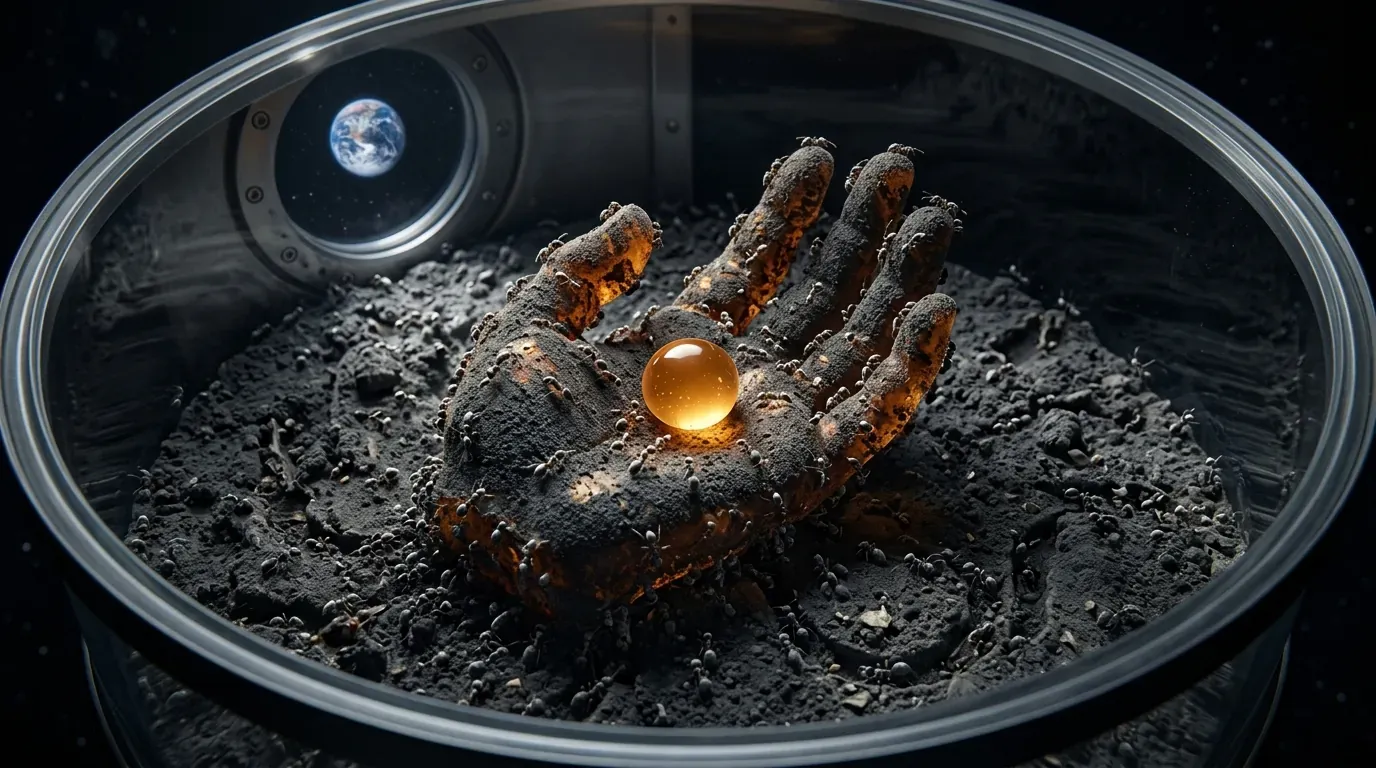
In the enclosure behind them, the ants worked on a final structure. It was the largest yet—nearly four centimeters tall—and it was unmistakable. A human hand, cupped. And in the palm, a tiny sphere of honey, glowing faintly under the UV lights, waiting for someone to reach in and accept it.
No one had yet. But Melon had a feeling that someone would. Maybe soon. Maybe just in time.
The ants kept calling Earth. And Earth, for the first time, was beginning to listen.